
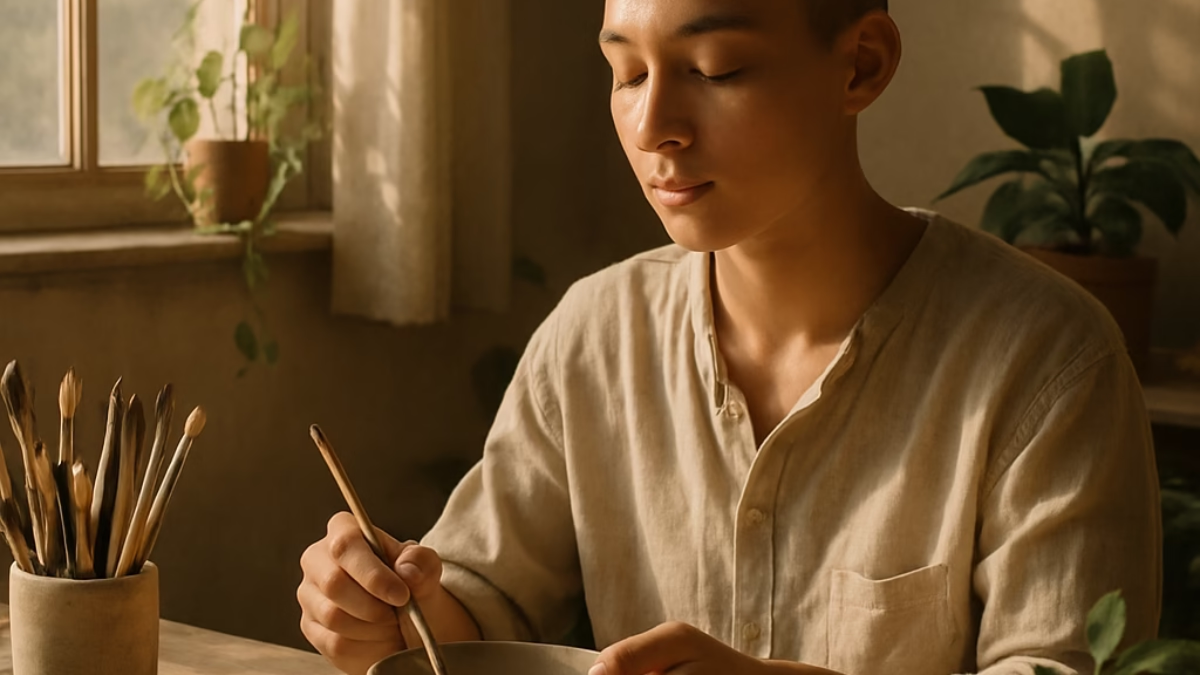
Around the world, people are quietly revolutionizing their kitchens, studios, and unused spaces in apartments by picking up paintbrushes, tuning ukuleles, arranging tiny succulents, and disassembling old radios—not to brag on social media, but simply to breathe. Once categorized as “a hobby” or “a career path,” creativity is quickly evolving into a useful tool for mental equilibrium. The mindful maker is aware of something that both science and sages have proposed: creating with attention, both for the final product and the process, can calm the nervous system, improve concentration, and foster joy.
How does mindful making calm the mind?
When we make, several beneficial things occur simultaneously. The creator first goes into a focused attentional state that is similar to what psychologists refer to as “flow,” a joyful state in which worry fades and time seems to slow down. Flow isn’t magic; it’s the brain balancing skill and challenge so that focus is totally focused and rumination has nowhere to go.
The steady stroke of a pen, the smell of wet clay, or the rhythm of cutting paper are examples of predictable sensory anchors that come from creative practice. Similar to how a steady metronome calms a stuttering heartbeat, these gentle, repeated inputs down-regulate the fight-or-flight system.
The creative process reframes “mistakes” as a necessary component of discovery and encourages experimentation. Our response to uncertainty is rewired by that change from judgment to curiosity. Rather than panicking over a mistake, the mindful maker asks, “What else might this be?” and continues.
Developing an interactive invitation: A 10-minute maker ritual
You do not need a studio. You need two things: permission and ten minutes.
- Choose a simple medium: a blank sheet of paper, a ball of yarn, a mug and a washable marker, or a small pile of kitchen herbs.
- Set a timer for 10 minutes without any outcomes and judgments.
- Begin with a breath. Inhale for four counts, exhale for six.
- Start making: doodle a single continuous line, tie a loose knot, arrange three leaves into a pattern, sketch a shape and add one colour.
- If your mind wanders, gently bring it back to the tactile sensation of making.
- When the timer rings, pause and name aloud one tiny feeling (“calm,” “surprised,” “a bit restless”). Then, if you wish, take a photo — or not.
This short ritual will not solve everything, but it creates a micro-habit with a tangible cue that equals creativity to centering.
The Creative acts that double as mindful practices
- Clay or dough shaping. The squish of material under fingers is a direct sensory tie to the present moment. It responds to pressure and cadence with immediate feedback that quiets speculation.
- Collage-making. Choosing images, cutting, and pasting encourages selective attention and narrative play. Collage is forgiving, when fragments rearrange, new meanings emerge.
- Sound loops or rhythmic tapping. Repeating a simple rhythm on a table or building a tiny loop on a phone app helps synchronize breathing and motor patterns.
- Gardening micro-tasks. Planting a seed, checking soil, clipping a leaf, as these small rituals connect us to cycles larger than our worry.
- Hand-lettering or calligraphy. The intentional strokes demand stillness; mistakes are aesthetic choices.
The point is to keep materials visible and low-effort. The more friction between you and making, the less likely it becomes a habit.
Why does the brain benefit from understanding briefly and kindly?
Experience is catching up to neuroscience. Focused making activates reward and attentional brain networks. Dopamine, the “feel-good” neurotransmitter, is released in gradual, sustained doses when small creative tasks are completed. Repetitive physical activities also reduce anxiety by calming the brain’s alarm centre, the amygdala. Maintaining a small maker log or socially sharing a creation enhances identity and agency, two powerful stress-reduction strategies.
Beyond calm: curiosity, connection, and meaning
Creativity with mindfulness fosters curiosity in addition to lowering stress. Tinkering makes you an experimenter in your own life; you test small hypotheses and ask “what if?” You become more engaged in relationships, more receptive to new ideas at work, and more resilient to failure as a result of that posture.
Making can also be a bridge. Craft nights, plant exchanges, or co-creation with a child are examples of connection rituals that endure beyond a single item. Even a small doodle can start a conversation that might otherwise stall.
Common obstacles and simple workarounds
- “I’m not talented.” Talent is a later concern. The first step is curiosity, not critique. Start with tasks where failure is funny (collage, doodles).
- “I don’t have time.” Try the 10-minute ritual. Micro-habits compound.
- “I get frustrated.” Swap to tactile or rhythmic activities — they tend to lower frustration faster than precision tasks.
- “It feels self-indulgent.” Reframe: you’re investing in your capacity to be present and productive. Creativity is self-care with returns.
Rituals that make creativity stick
- Anchor it to an existing cue. After your morning tea, doodle for five minutes. Pairing new habits with old ones increases consistency.
- Designate low-stakes days. “Sketch Sundays” or “Tinker Tuesdays” reduce the pressure to produce.
- Keep a maker ledger. Record one line about what you made and how you felt. Over weeks you’ll have a visible trail of micro-wins.
- Play publicly sometimes. Posting a tiny creation or gifting it can increase motivation and social reward.
This micro-practice engages senses and motor action, that is anchoring the mind faster than a single breath alone.
Parting thoughts: When therapy and making meet together
Many people find that their creative endeavors enhance their therapy. Making is a nonverbal way to process emotions in art and music therapy. It’s actually helpful information if the maker ritual elicits strong emotions because it indicates that creative practice is reaching deep inside. Discuss incorporating making into your treatment plan with your clinician if you are currently undergoing treatment. Fundamentally, the mindful maker develops a position: small actions over perfection, process over product, and curiosity over criticism. The perseverance of the tinkerer becomes emotional resilience, and the patience of the craftsman becomes the patience of the mind. Although creativity is not a panacea, it is a dependable, low-risk activity that consistently yields something vital: presence.
Sources Referred-
https://www.health.harvard.edu
https://www.flowresearchcollective.com
https://www.ted.com/talks/elizabeth_gilbert_your_elusive_creative_genius
https://www.psychologytoday.com/us


Add a Comment