
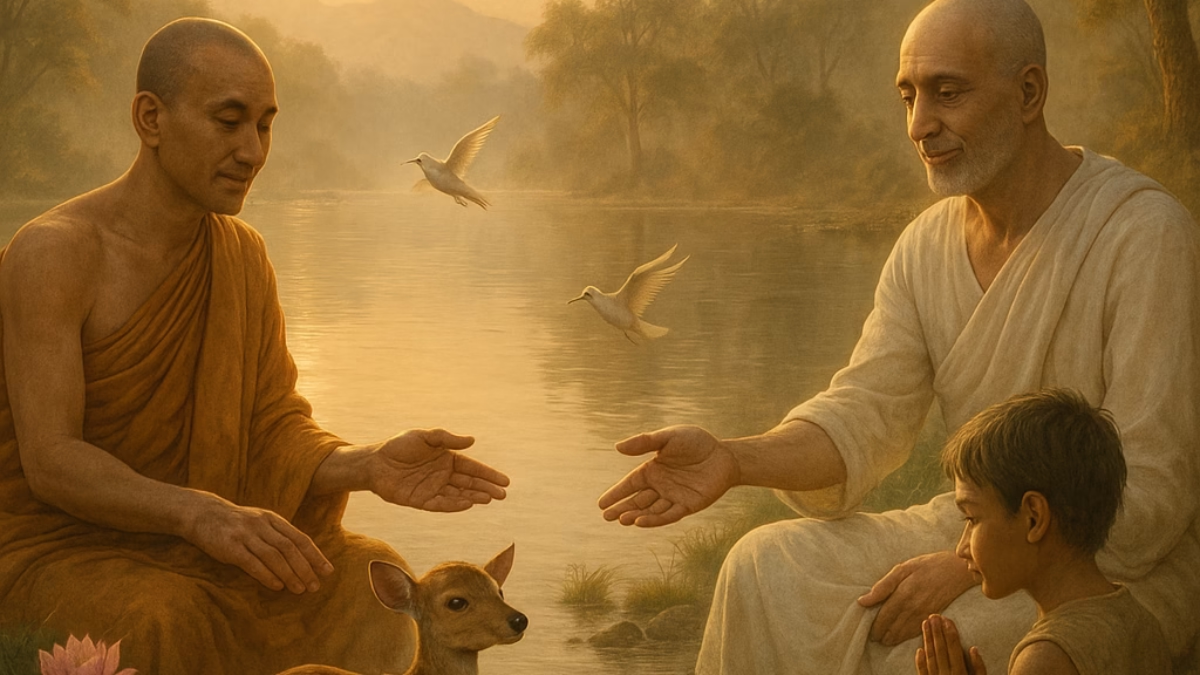
In an age of restlessness in terms of ambitions, widening divides, and emotional exhaustion, one ancient virtue continues, which is to offer a balm to the modern soul, that is Karuna or Compassion. The concept has been derived from a Sanskrit word that means ‘to act.’ Karuna is not a passive sentiment, but it is a call for active empathy, which involves taking action to heal the pain of others. Across millennia, it has remained the cornerstone of spiritual, ethical, and social evolution in the Indian Philosophical Thought. From chants of the Vedas to Meditations of Buddha, from Jain ascetics to modern yogis, Karuna is the lifeblood of Dharma or the very vibration that harmonizes the self and cosmos.
This article will explore the concept of Karuna as not merely an emotion, but as a spiritual force or a divine resonance that can transform individual consciousness and collective destiny.
The Divine Origin of Karuna
In the ancient languages of Sanskrit and Pali, the concept of Karuna is translated as compassion, mercy, or a wish to relieve suffering. It is far more than virtue; it is also the echo of divinity within the human heart. The Rig Veda describes God as ‘Dayalu’ or Compassionate beings who sustain creation through benevolence. The Upanishads expand upon this vision, where it states that compassion is not a virtue one attains, it is the essence of Brahman that one remembers.
According to the Hindu philosophy, there lies a differentiation between Daya (Kindness) and Karuna (Compassion). Daya is an external expression of goodwill, which is defined as acts of generosity and moral duty. Karuna arises from the identification of someone else’s sufferings, it is empathy spiritualized and emotion sanctified by wisdom. To feel Karuna or compassion is to dissolve the illusion of separation, or see the same Atman in oneself and others.
Karuna according to the Bhagavad Gita
Few scriptures have captured the active spirit of Karuna better than the Bhagavad Gita. Lord Krishna’s counsel to Arjuna is steeped in compassionate wisdom, not sentimentality but an empathy rooted in Dharma. The true warrior, Krishna declares that, “one who protects the weak and defends righteousness with a heart free of hatred. Compassion here becomes the strength with the courage to act without ego, violence, and vengeance.
In ancient India, compassion was not confined to human relationships. It extended to rivers, forests, animals, and celestial beings. The sages expressed this cosmic empathy through Havan, Homa, and Yajna sacred fire rituals performed not for personal gai, but for the welfare of Sarva Bhuta, all living beings. Each mantra chanted into the flames was an offering of gratitude to creation itself. Texts like the Brahmanas and Upanishads describe these rituals as acts of ecological balance in early expressions of environmental ethics. The sages understood that compassion for nature is compassion for the self, for all are interwoven in the web of Prakriti. However, texts like the Brahmanas and Upanishads describe these rituals as acts of ecological balance, or an early expression of environmental ethics. The sages understood that compassion for nature is compassion for the self, for all are interwoven in the web of Prakrti.
Even in the present day, when mass mediations or Yajnas are performed in the religious sites in India, many believe the surrounding atmosphere to be purified. Interestingly, modern research supports this, as per studies by Harvard Medical School and other institutions, including works of Dr. Herbert Benson, show collective mediation can lower crime rates, reduce stress indicators, and promote social coherence. Compassion seems not only moral but measurable.
Karuna in Buddhism: The Path of the Bodhisattva
In Buddhism, Karuna is one of the Four Brahmaviharas, known as the “divine abodes” which led one to enlightenment, along with Metta (loving-kindness), Mudita (joy), and Upekkha (equanimity). Compassion must be cultivated, according to the Buddha, until it is spontaneous, which is a twitch in the heart that occurs upon seeing suffering, which drives one to action. The Karaniya Metta Sutta describes this practice: “As a mother would tenderly protect her only child at the risk of her own life, even so should one cultivate boundless love for all beings.”
In Mahayana Buddhism, the Bodhisattva ideal, where the individual who delays Nirvana out of sympathy for others, represents the absolute expression of Karuna. Compassion here is the very pulse of enlightenment. Practices such as Tonglen in Tibetan Buddhism go even further, breathing in others’ pain and breathing out healing and peace. As Pema Chodron explains, “We begin to take care of ourselves and others; we begin to love without fear.”
Compassion in Jainism: The Ethic of Nonviolence
For the Jains, Karuna takes the form of Ahimsa, the core principle of Jainism. The Acaranga Sutra states that accidental injury binds one to karma. Compassion, therefore, rules all of Jain life, from the diet that refrains from harm to the insects and microbes, to the language that refrains from cruelty. Compassion is purification itself, the very gateway to Moksha.
Karuna as Dharma and Spiritual Development
Karuna is focused on Dharma, not as feeling but as a responsibility to the whole. In human relations, it is empathy, forgiveness, and service. In the spiritual realm, it is the very vehicle of suffering. By virtue of compassion, one breaks down the ego, awakens to unity, and experiences stillness and peace that arises from oneness.
In the Yoga Sutras, Patanjali cautions about Abhinivesa, being attached to life in the face of fear, the greatest obstacles to compassion. Fear separates, compassion unites. Where there is Karuna, fear is lost. With Karuna, the self can extend beyond body and mind.
Practicing Karuna in Daily Life
The practice of compassion begins with being present, being present on purpose, as opposed to reacting to the Chitta Vṛttis (thoughts) that throw your clear judgment off. There are many ways we can practice compassion:
- Compassionate Listening – Listening to or hearing another’s pain without judgment.
- Service – Meaningful small action that creates ripples outward into transformation.
- Self-Compassion – Treat yourself like you treat others.
- Fearlessness – Only those who do not fear can love deeply and act selflessly.
Meditative practices like Metta Bhavana (Loving-kindness meditation) train the mind to radiate compassion outward. Firstly, to heal oneself, then loved ones, and then to all beings. Neuroscientific studies at Stanford University’s Centre for Compassion and Altruism Research (CCARE) led by Dr. James Doty reveal that such practices activate the neural circuits associated with joy and empathy, proving that compassion is a biologically rewarding nature’s design for collective well-being.
The worldwide significance of Karuna
In light of the current global crises of inequality, climate change, and anxiety, Karuna emerges as a spiritual revolution and a moral compass. From Buddha, Mahavira, and Ramakrishna Paramahamsa to Rama and Krishna, compassionate leadership has always been the hallmark of civilizational advancement. This age-old wisdom is reflected in modern psychology. The Dalai Lama’s teachings on “secular compassion” and Dr. Paul Gilbert’s Compassion-Focused Therapy show that empathy is a survival quality that benefits both individuals and societies.
Conclusion
The River of Compassion Flows from the Divine. Karuna is not learned, rather it is remembered. It flows spontaneously when the heart is cleansed of ego and the intellect attuned to truth. As the Ganga flows from Shiva’s crown to purify the earth, compassion flows from the awakened heart to purify mankind. At its greatest, Karuna is not feeling but awareness that the pain of one is the pain of all. It is the beat of divinity in every heart, beckoning us to act, to heal, and to love unconditionally. To be with Karuna, therefore, is to be as the universe is in harmony, in service, and in unity.
Sources Referred-
https://www.beingshiva.org/post/the-heartbeat-of-humanity-embracing-karu%E1%B9%87%C4%81-compassion
https://www.wisdomlib.org/concept/karuna#google_vignette
https://www.hinduwebsite.com/divinelife/essays/compassion3.asp
https://www.lionsroar.com/buddhism/compassion-karuna
https://ahymsin.org/docs2/News/202004/04.html
https://jaingpt.org/knowledge/karuna_jiv_ki_shubh_parinati_210346_210346


Add a Comment