
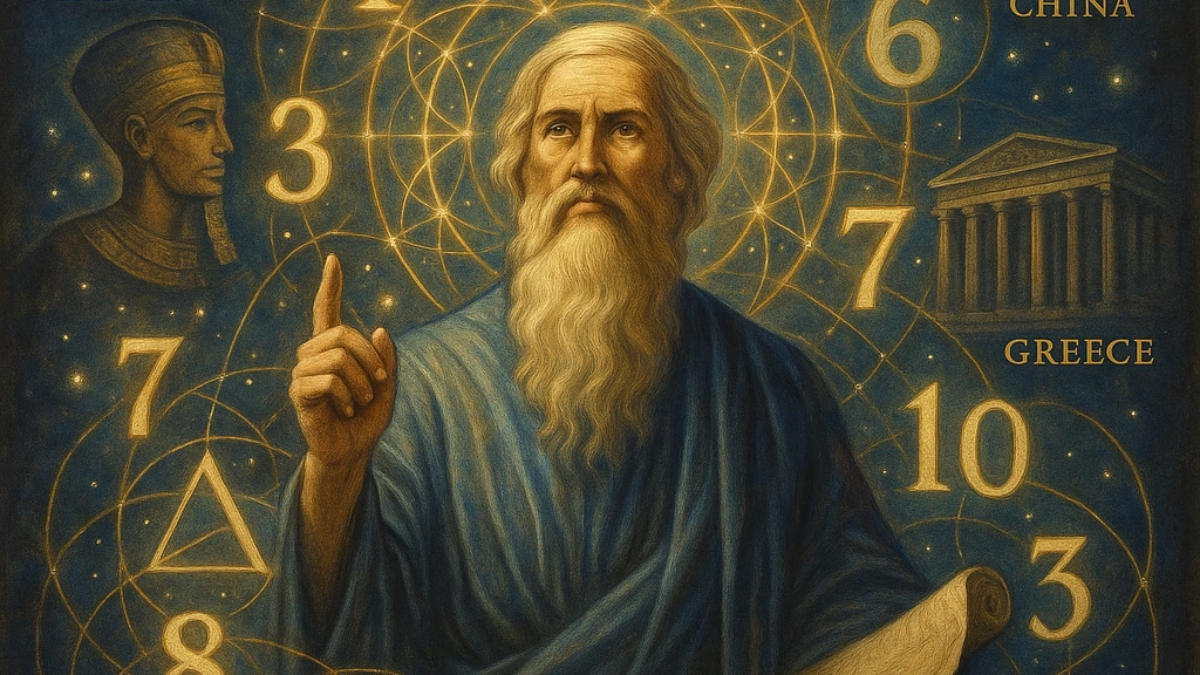
The Timeless Language of Numbers
Numbers are everywhere, etched in every rhythm and structure of our lives and the cycles of nature. Yet long before mathematics became a science of calculation and logic, they were seen as symbols of divinity, or carriers of hidden meaning that connected the earth to the cosmic. This is the story of numerology, a discipline that is as old as it can be expected. One that reveals humanity’s ancient attempt to decode the universe through the mystic language of numbers. Starting from the temples of Babylon to the sacred geometries of Egypt and the philosophical halls of Greece, the use of numbers has long been associated with destiny, personality, and cosmic harmony. Among those who had elevated the use of numbers to a spiritual principle was Pythagoras, the enigmatic philosopher-mathematician whose ideas gave numerology a profound philosophical foundation that resonates till date.
The Ancient Origins of Number Mysticism
The origins of the history of Numerology trace back to 4,000 years ago, which finds its earliest expressions in the great civilizations of Babylon, Egypt, and China.
In Babylon, the cradle of astrology and divination, numbers were believed to carry messages from the gods. Babylonian numerologists had built their systems around the number 60, considering it perfect for its rule of divisibility, and used it for measuring time and predicting celestial movements, a legacy that survives in our 60-minute hours and 360-degree circles.
In Egypt, the numbers were considered sacred symbols that intertwined with religious beliefs. Egyptian priests interpreted the numerical values of names and events to foretell outcomes and align themselves with divine will. Numbers guided the architecture of temples, funerary rituals, and even the mysteries of the afterlife, recorded in the ‘Book of the Dead.’
In China, numerical harmony shaped the ideals of philosophy and the course of daily life. The ‘I Ching,’ which is one of the oldest Chinese texts, has used numerical patterns to interpret fate. Chinese numerology associated each number with yin or yang energy, and the five elements form a framework for balance and cosmic order.
Pythagoras: The Philosopher who heard the Music of the Universe
If the East laid the foundation for number mysticism, ancient Greece transformed it into philosophy. Around the 6th Century BCE, a Greek thinker named Pythagoras revolutionised humanity’s understanding of numbers. Though it remains shrouded in mystery, so much so that the scholars debated whether the ‘Pythagoras’ we know was a single historical figure or a composite of several minds, his influence remains undeniable.
Pythagoras believed that numbers governed the structure of the universe, from the movement of planets to the notes of a lyre. He saw numbers as living principles, each with a distinct personality and cosmic significance. For example;
- The number one stood for unity, the source of all things.
- The number two stood for the feminine principle and duality.
- The masculine principle was symbolized by the number three.
- The number four represented stability, justice, and balance.
- The most sacred number, 10, stood for perfection, the sum of 1 + 2 + 3 + 4, denoting that unity arises from multiplicity.
Even geometry was sacred to the Pythagoreans: one point represented existence, two points represented a line, three points represented a surface, and four points represented space. Therefore, numbers were the blueprint of reality rather than abstract concepts.
The Harmony of Spheres
The most captivating idea of Pythagoras was ‘harmony of the spheres.’ It was over observing how musical notes correspond to the specific string lengths discovered by him. The harmonious sounds which emerged when the strings vibrated in simple whole-number ratios, like 1:2 (the octave), 2:3 (the fifth), and 3:4 (the fourth). He made a profound leap from this, as if musical harmony was governed by numerical ratios. Pythagoras proposed that the plants produced an inaudible symphony, where a celestial music was generated by their orderly motion through space. Though modern science does not recognise this literal harmony, the metaphor has been profoundly shaped by Western thoughts. It inspired later thinkers like Johannes Kepler, whose ‘music of the spheres’ linked planetary motion to divine proportion, and eventually contributed to the notion of a mathematically ordered universe, which culminated in Newton’s Law of Gravity.
Thus, from music to astronomy, Pythagoras turned numbers into a universal philosophy where mathematics, art, and spirituality converged.
The Pythagorean School: Recognising the importance of numbers as a way of life
Pythagoras founded a brotherhood that was part of a philosophical school. Its members followed strict rules of conduct, vegetarianism in dietary practices, and secrecy. For them, numbers were sacred tools for purifying the soul and understanding the divine order. The Pythagoreans also believed the cosmos to have been built upon mathematical harmony and that understanding these patterns led to spiritual enlightenment. They visualised numbers using dots, or ‘Arithmoi,’ forming geometric figures like triangles (1, 3, 6, 10…) and squares (1, 4, 9, 16…). These figures are still found among the mathematical terminologies at present.
Their cosmology was equally symbolic, as they believed in the nine known celestial bodies, the Sun, Moon, Mercury, Venus, Earth, Mars, Jupiter, Saturn, and a mysterious ‘Central Fire.’ But since 10 was considered perfect, they postulated a tenth hidden body, the ‘Counter-Earth,’ forever invisible behind the Sun. This belief reflected their conviction that numerical perfection must be mirrored in the heavens. The Pythagorean with order, proportion, and symmetry influenced everything from Greek architecture to Renaissance art. More than a philosophy, it was a worldview. It managed science, aesthetics, and spirituality through the unifying power of numbers.
Numerology Through the Ages
The belief that numbers disclose cosmic truths endured throughout the Middle Ages and the Renaissance after Pythagoras. Kabbalistic numerology was created by Jewish mystics, who used the numerical values to reveal messages from God. By using biblical symbolism to interpret numbers like 7 for creation, 12 for apostles, and 40 for trials, early Christian intellectuals gave a mathematical meaning to spirituality. Numerology saw a resurgence in the 20th century during the New Age movement. The term “Numerology” was created by Dr. Julian Stenton, who combined traditional ideas with contemporary psychology and self-help culture. Numerology is now easily accessed through digital calculators and apps that combine technology and mysticism to determine the path of life or compatibility in relationships.
Ancient Wisdom and Modern Reflection
Despite its mystical allure, numerology remained outside the realm of science. There is no empirical evidence that numbers can predict destiny or personality. Yet its enduring relevance may not lie in accuracy, but in introspection.
Numerology challenges us to rethink numbers as meaning-filled symbols or mirrors reflecting our inner selves in a world where data and algorithms rule together. It serves as a reminder that numbers are used to express something more profound, realizing our need for structure, meaning, and a sense of connection to the universe.
Numerology provides frameworks for self-understanding in contemporary practice:
- The Life Path Birthdate-based numbers reveal traits and difficulties in a person’s personality.
- Name numbers reveal personality vibrations.
- Compatibility Readings use numerical harmony to examine relationships.
Numerology continues to evolve, incorporating age-old wisdom into modern life, whether it is used as a personal compass or as a contemplative exercise.
The Enduring Allure of Numbers
Numbers have captivated human imagination for millennia, from the Babylonian star charts to the ancient Greek lyres. While the Pythagoreans may not have discovered the laws of physics, they did discover something equally profound, with the realization that order, beauty, and meaning are intertwined through number. Their vision of a harmonious cosmos continues to resonate today, whether in the poetic symbolism of numerology or the elegant equations of science. In the end, numerology’s story is the story of humanity’s quest to understand itself, to find meaning in the silent rhythm of existence and pattern in chaos. As we trace its journey through ancient civilizations and into our digital age, one truth endures that numbers speak, provided we follow them correctly.
Sources Referred-
https://www.britannica.com/topic/number-symbolism/Pythagoreanism
https://rajneespiritualhealer.com/tracing-the-roots-of-numerology


Add a Comment