
For centuries, traditional Ayurvedic and East Asian medical systems utilized natural botanical formulations to cultivate resilience, elevate mental clarity, and restore internal equilibrium. In our modern high-velocity environment, the boundary separating historical herbalism from advanced neurobiology is rapidly dissolving. The pursuit of cognitive enhancement has evolved far beyond the short-sighted reliance on high-dose synthetic stimulants, caffeine overload, and unverified smart drugs. Today, researchers, biohackers, and medical professionals are turning to adaptogen chemistry to foster long-term cognitive endurance, protect against neuro-degeneration, and stimulate structural neuroplasticity.
By examining time-tested Asian medicinal herbs through the lens of modern molecular biology, scientists are uncovering how active plant constituents interact with complex neural pathways. Furthermore, combining these standardized botanical extracts with targeted synthetic nootropic stacking, continuous metabolic tracking through continuous glucose monitoring, and precise neuro-imaging analysis provides an empirical framework that transforms ancient wisdom into a modern quantitative science.
Deciphering the Biochemical Architecture of Botanical Adaptogens
Adaptogens are defined as biological substances that increase the overall capacity of an organism to adapt to environmental stressors while normalizing cellular functions. Unlike classical pharmaceutical stimulants that force non-physiological releases of neurotransmitters at the expense of metabolic depletion, adaptogens exert a subtle, stabilizing influence on the hypothalamic-pituitary-adrenal axis. This systemic regulation prevents the neurotoxic cascades associated with chronic stress.
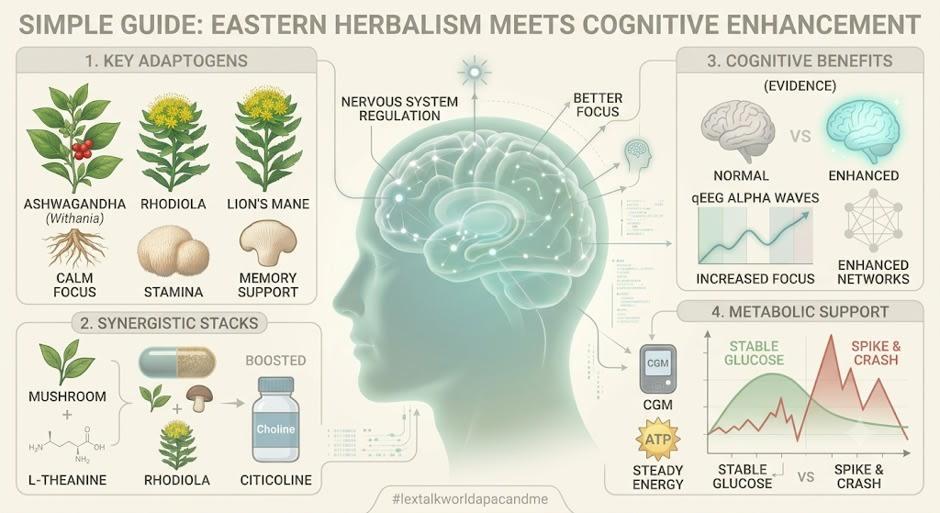
Ashwagandha, known botanically as Withania somnifera, stands as one of the most thoroughly researched herbs in the Ayurvedic pharmacopeia. The principal bioactive components of Ashwagandha are a group of steroidal lactones termed withanolides. At the neurological level, withanolides readily cross the blood-brain barrier and modulate gamma-aminobutyric acid receptors. By enhancing inhibitory neurotransmission, Ashwagandha mitigates central nervous system hyper-arousal. Simultaneously, it significantly reduces circulating serum cortisol levels, shielding delicate hippocampal structures from cortisol-induced neuronal atrophy and preserving executive decision-making capabilities under severe pressure.
Rhodiola rosea operates through a distinct biochemical pathway that targets mental stamina and fatigue resistance. Native to the high-altitude regions of Asia and Northern Europe, Rhodiola contains potent bioactive polyphenols known as salidrosides and rosavins. These active constituents function as natural inhibitors of monoamine oxidase enzymes, specifically monoamine oxidase A and B. By slowing down the enzymatic degradation of key neurotransmitters such as dopamine, norepinephrine, and serotonin within the prefrontal cortex, Rhodiola prolongs mental alertness. It enables sustained focus during demanding analytical tasks without inducing the autonomic stress response associated with central nervous system stimulants.
Lion's Mane mushroom, or Hericium erinaceus, addresses the physical structural foundation of cognitive architecture. The primary medicinal compounds isolated from Lion's Mane are low-molecular-weight diterpenes known as hericenones and erinacines. Erinacines, in particular, are capable of crossing the blood-brain barrier to stimulate the endogenous synthesis of Nerve Growth Factor within astrocytes and cortical neurons. Nerve Growth Factor is an essential neurotrophin that regulates the differentiation, growth, maintenance, and repair of cholinergic neurons. Regular administration of standardized Lion's Mane extract accelerates neurite outgrowth, enhances synaptic plasticity, and promotes hippocampal neurogenesis, thereby improving memory consolidation and learning retention.
Strategic Nootropic Stacking and Quantitative Neuro-Imaging
Although individual adaptogenic herbs offer remarkable neuroprotective benefits, their full potential is unlocked when integrated into precise nootropic stacks. Nootropic stacking involves the intentional combining of botanical adaptogens with specific neurochemical precursors and synthetic compounds to generate synergistic neurological outcomes.
A prime illustration of targeted cognitive synergy is the combination of Lion's Mane mushroom with Citicoline and L-Theanine. Citicoline serves as a potent choline donor and precursor to phosphatidylcholine and acetylcholine, supplying the essential raw materials required for high-speed neurotransmission and structural cell membrane repair. When Citicoline is paired with the Nerve Growth Factor stimulating properties of Lion's Mane, the central nervous system experiences simultaneous structural neurogenesis and enhanced neurotransmitter availability. The addition of L-Theanine, an amino acid extracted from green tea leaves, modulates glutamate receptors and increases localized alpha-wave activity in the brain, fostering a state of calm, relaxed concentration.
To measure the effectiveness of these intricate cognitive formulations, modern neuroscientists rely on non-invasive neuro-imaging technologies. Quantitative electroencephalography allows researchers to observe real-time alterations in brain wave frequency distribution following adaptogen administration. Studies reveal that optimized adaptogenic stacking produces a noticeable elevation in alpha band power (8 to 12 Hertz), which correlates directly with effortless focus, creative problem solving, and reduced mental anxiety.
Furthermore, functional magnetic resonance imaging provides visual mapping of functional connectivity across major neural networks. High-resolution functional magnetic resonance imaging scans indicate that long-term adaptogenic usage enhances connectivity within the Executive Control Network while downregulating hyper-activity within the Default Mode Network. This shift in network dynamics allows individuals to maintain deep, immersive focus on task-relevant information without succumbing to internal distraction or rumination.
Metabolic Optimization via Continuous Glucose Monitoring
Brain health and cognitive longevity are inextricably tied to metabolic stability. Although the human brain comprises roughly two percent of total body weight, it consumes approximately twenty percent of the resting energy budget of the body, relying primarily on a continuous supply of blood glucose. Fluctuations in blood glucose levels lead directly to cognitive impairment, which manifests as brain fog, executive dysfunction, and emotional instability.
The integration of continuous glucose monitoring technology has opened new frontiers in cognitive biohacking. By wearing a small subcutaneous continuous glucose monitor sensor, individuals can observe real-time glycemic responses to dietary inputs, cognitive stress, and adaptogenic supplementation.
Botanical adaptogens exert significant metabolic regulatory effects that directly benefit brain function. Withanolides from Ashwagandha enhance peripheral and central insulin sensitivity, facilitating efficient glucose transport into neural tissue via glucose transporter proteins. Salidrosides from Rhodiola activate adenosine monophosphate-activated protein kinase, a cellular energy master switch that stimulates mitochondrial adenosine triphosphate production and protects neural cells against metabolic stress.
By utilizing continuous glucose monitoring data, researchers can calibrate adaptogenic stacks to smooth out glycemic variability. Eliminating postprandial glucose spikes and subsequent reactive hypoglycemic crashes ensures a steady, unbroken supply of energy to the brain. This metabolic stabilization allows knowledge workers, athletes, and researchers to sustain intense mental throughput for extended working periods without experiencing cognitive burnout.
The Future of Integrative Cognitive Science
The convergence of Eastern herbalism and modern neurobiology represents a paradigm shift in human capacity engineering. Individuals are no longer confined to choosing between ancient empirical remedies and rigid pharmaceutical interventions.
By combining standardized adaptogenic chemistry, synergistic nootropic stacking, real-time continuous glucose monitoring, and objective neuro-imaging, cognitive enhancement has matured into a rigorous, data-driven science. Honouring the holistic systemic balance of traditional Asian and Ayurvedic medicine while utilizing cutting-edge neuro-scientific diagnostics grants humanity unprecedented tools for optimizing mental endurance, fostering lifelong neuroplasticity, and expanding human cognitive potential.