
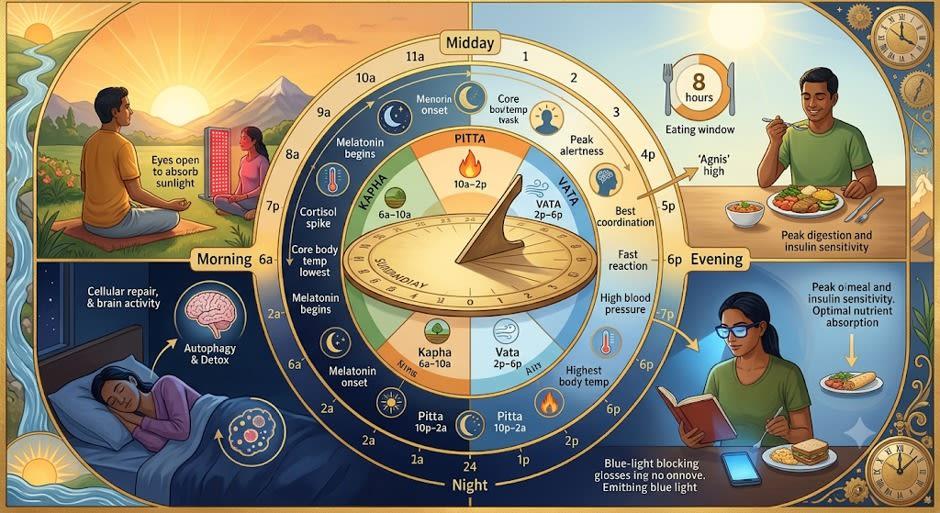
Thousands of years before quantum physics, molecular biology, or the discovery of the suprachiasmatic nucleus, ancient Ayurvedic scholars documented a comprehensive framework for health known as Dinacharya. Translated literally as the daily code of conduct or daily routine, Dinacharya was built on a single core truth: human health relies on synchronizing daily habits with the movement of the sun. In the modern era, circadian biology has uncovered the exact cellular mechanisms behind this ancient wisdom. Modern life disrupts natural bio-rhythms through constant exposure to artificial screen light, late-night snacking, and erratic sleep schedules, leading to metabolic friction, hormonal imbalances, and chronic cellular fatigue. Bridging the wisdom of Dinacharya with light therapy and time-restricted feeding offers a powerful blueprint for restoring metabolic health, sharpening focus, and enhancing longevity.
Understanding the Science of Daily Biological Rhythms
To understand why this synthesis matters, one must examine how both systems map out the day. Microscopic clocks exist inside every cell of the human body, dictated by a central master pacemaker located within the hypothalamus. This central clock relies on external light signals to keep internal cellular processes synchronized. When light hits the eyes, it signals to the body whether it is time to release cortisol for alertness or melatonin for recovery.
Ayurveda describes this exact rhythm through three energetic phases, known as Doshas, which govern specific time blocks throughout a twenty-four-hour period.
Kapha Phase (6:00 AM – 10:00 AM & 6:00 PM – 10:00 PM): Marked by physical earthiness, stability, and slow movement. In the morning, it requires movement to clear sluggishness. In the evening, it provides natural grounding for rest.
Pitta Phase (10:00 AM – 2:00 PM & 10:00 PM – 2:00 AM): Governed by the fire element. Midday represents peak digestive capacity, while midnight represents peak metabolic and cellular detox activity.
Vata Phase (2:00 PM – 6:00 PM & 2:00 AM – 6:00 AM): Governed by movement and air. Afternoon brings creative mental activity, while early morning before sunrise offers clear, subtle mental awareness.
When modern schedules ignore these bio-rhythms, metabolic confusion sets in. Reclaiming optimal health requires aligning daily habits with both traditional guidelines and modern tools.
Morning Integration: Morning Solar Exposure and Morning Movement
The morning routine establishes the biological baseline for the entire day. Ayurveda insists on rising during the pre-dawn Vata period to clear bodily tissues and align the mind before the heavy Kapha energy settles in.
Modern circadian science validates this practice. Getting direct sunlight into the eyes within thirty minutes of waking triggers specialized photoreceptor cells in the retina. These receptors send immediate signals to the brain to kickstart morning cortisol production, boost core body temperature, and start an automatic countdown timer for melatonin release later that night.
To optimize the morning hours:
Natural Morning Sunlight: Step outside for ten to fifteen minutes shortly after sunrise without wearing sunglasses. Sunlight sends a clear signal to your internal clock that the daily cycle has begun.
Red and Near-Infrared Photo biomodulation: If sunrise light is unavailable due to season or location, spending ten minutes in front of a medical-grade red light therapy panel can deliver red and near-infrared wavelengths directly to the mitochondria, boosting cellular ATP production and clearing morning grogginess.
Gentle Kapha-Clearing Movement: Engage in light exercise, stretching, or yoga between 6:00 AM and 8:00 AM to stimulate lymphatic drainage, encourage bowel movements, and clear lingering metabolic waste.
Midday Integration: Peak Digestive Fire and Time-Restricted Feeding
One of the foundational rules of Dinacharya is that Agni, the digestive fire, directly tracks the height of the sun in the sky. As the sun reaches its highest point between 10:00 AM and 2:00 PM, the digestive organs produce their highest concentration of stomach acid and metabolic enzymes. Consequently, Ayurveda prescribes eating the largest, most nutrient-dense meal of the day precisely during this window.
Modern gastroenterology and chronobiology strongly confirm this approach. Insulin sensitivity, gastric motility, and nutrient assimilation all peak during the midday hours. Eating heavy meals late in the evening strains metabolic capacity, leading to elevated blood glucose levels throughout the night and impaired fat oxidation.
Integrating time-restricted feeding into Dinacharya provides a structured model for metabolic restoration:
The Eight-to-Ten Hour Feeding Window: Restrict daily caloric intake to an eight-to-ten hour window, starting around 8:00 AM or 9:00 AM and closing by 5:00 PM or 6:00 PM. This aligns food intake with optimal digestive enzyme production.
The Midday Anchor Meal: Make the lunch meal the primary source of complex carbohydrates, healthy fats, and proteins. Because the digestive system operates at maximum efficiency during this window, the body processes these calories for clean energy rather than storing them as excess fat.
Early, Light Suppers: Eat a light dinner during the early evening Kapha phase. Consuming soups, steamed vegetables, or light proteins before 6:30 PM ensures that digestion is largely complete before bed, freeing up energy for cellular repair.
Evening Integration: Blue-Light Mitigation and Cellular Regeneration
The final phase of the circadian cycle governs recovery, detoxification, and tissue regeneration. In Ayurveda, the period between 10:00 PM and 2:00 AM is governed by internal Pitta energy. Rather than digesting external food, this nightly fire is meant to digest internal waste, clear cellular debris, and repair internal tissues.
If a person stays awake past 10:00 PM or consumes late-night snacks, the body redirects its energy back toward gastrointestinal digestion. This deprives the brain and liver of crucial deep-cleaning processes.
Furthermore, artificial blue light emitted by smartphones, televisions, and indoor LED bulbs tricks the brain into believing it is still bright noon. This suppresses natural melatonin secretion, disrupts sleep architecture, and prevents deep delta-wave sleep.
To optimize evening recovery:
Block Artificial Light After Sunset: Wear high-quality red- or amber-tinted glasses after sunset to filter out blue and green light wavelengths. Dim indoor lighting and switch off overhead fluorescent bulbs to encourage natural melatonin synthesis.
Utilize Near-Infrared Light: Spending fifteen minutes under red or near-infrared light in the early evening relaxes the nervous system, shifts the body into a parasympathetic state, and aids muscular recovery.
Honor the 10:00 PM Sleep Threshold: Retire to bed before 10:00 PM to take full advantage of the body's nightly repair window. Entering deep sleep before midnight maximizes growth hormone release and supports optimal brain detoxification through the glymphatic system.
Harmonizing Past Wisdom with Future Health
The Circadian Dinacharya demonstrates that ancient health principles and modern physiological discoveries are two ways of describing the same fundamental truth: human beings thrive when their habits match natural environmental rhythms. By combining the structured daily habits of Ayurvedic tradition with the precision of time-restricted feeding, strategic blue-light management, and red-light therapy, anyone can build a resilient daily routine. Returning to these natural rhythms provides a sustainable path toward steady energy, balanced hormones, robust digestion, and long-term vitality.