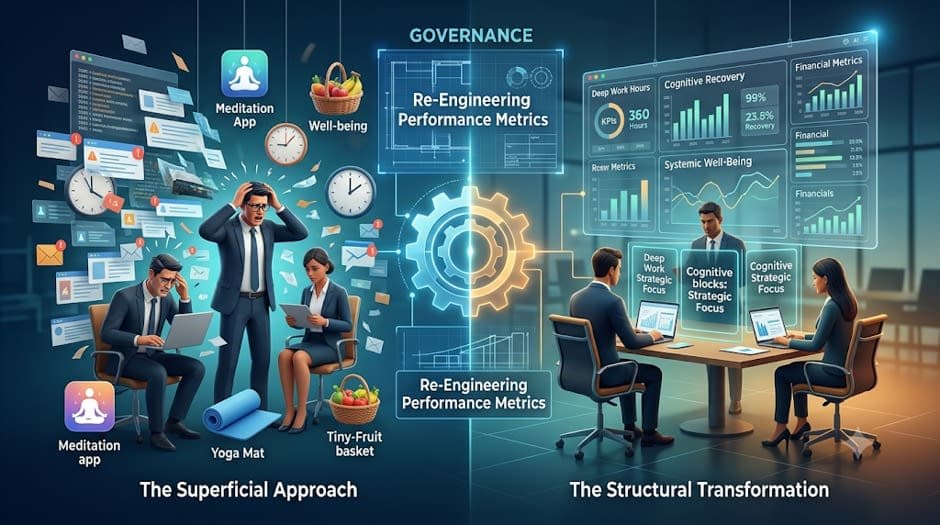
Enterprise leadership has long treated executive stamina as an inexhaustible natural resource. For decades, the standard organizational playbook addressed senior burnout through cosmetic benefits: sponsored mindfulness subscriptions, on-site gym passes, catered nutritional lunches, and executive retreats. While well-intentioned, these perks treat the symptoms rather than the disease. They place the burden of recovery entirely on the individual while preserving the structural pressures that drive cognitive collapse. When a company relies on superficial benefits to solve systemic exhaustion, it mistakes palliative care for enterprise design.
A quiet revolution is now taking place across corporate boards. Modern enterprises are beginning to realize that executive burnout is not a personal failure of resilience; it is a direct consequence of outdated enterprise performance indicators. High-stakes decision fatigue, unrelenting connectivity, and chronic psychological friction systematically degrade the prefrontal cortex, leading to impaired risk analysis, emotional detachment, and poor capital allocation. To protect enterprise value and leadership longevity, progressive boards are redesigning corporate governance to measure cognitive load, recovery cycles, and sustainable capacity directly alongside revenue targets.
The Failure of Superficial Well-Being Architecture
The traditional wellness industry inside corporate campuses operates on a flawed assumption: that brief wellness activities can counteract sixty-hour weeks filled with fragmented attention and constant fire-fighting. In reality, an executive running on three hours of disrupted sleep cannot meditate away the neurobiological impact of chronic cortisol secretion.
Perks often act as operational camouflage. They allow organizations to claim commitment to human capital while simultaneously rewarding behaviors that lead straight to mental exhaustion. When compensation frameworks, quarterly board audits, and promotion pathways celebrate twenty-four-hour availability and unyielding throughput, leaders receive a clear signal: your physical limits are inconvenient liabilities.
These dynamics foster an environment where cognitive impairment is actively subsidized. As executive exhaustion deepens, working memory shrinks and risk aversion either calcifies into decision paralysis or swings toward reckless haste. The financial cost of a single flawed strategic acquisition or poorly executed reorganization dwarfs any savings achieved by squeezing extra hours out of an overextended management team. If boards wish to mitigate leadership attrition and preserve corporate clarity, they must abandon cosmetic fixes and re-engineer the performance indicators that dictate executive life.
Measuring Cognitive Load and Work Architecture
Shifting well-being into governance requires objective, structural measurements of workload. Progressive enterprises are moving away from volume-based proxies of productivity, replacing them with metrics that capture workload quality, cognitive fragmentation, and decision density.
One primary operational metric is the ratio of deep, uninterrupted strategic work to fragmented communication. When a chief officer spends seven hours a day navigating back-to-back thirty-minute status meetings, the brain operates in a persistent state of context-switching. This constant shifting drains glucose and neurotransmitter reserves, leaving zero capacity for complex conceptual thinking. Organizations are now instrumenting work patterns to establish protected cognitive blocks, measuring executive schedules by the presence of uninterrupted intervals dedicated strictly to long-term planning and problem-solving.
Another crucial metric is communication boundary integrity. Forward-thinking firms audit after-hours digital traffic, asynchronous handoffs, and weekend operational interruptions. Tracking these flows does not serve to micromanage leaders; it reveals whether organizational structures are resilient enough to function without constant executive escalation. A leadership layer that must intervene round the clock indicates fragile systems, inadequate delegation protocols, and poor organizational design. Auditing systemic bottlenecks transforms workload sustainability from an abstract virtue into a measurable operational capability.
Institutionalizing Cognitive Recovery at the Board Level
Cognitive science has established that mental recovery is not an optional reward for hard work; it is an absolute physiological prerequisite for high performance. Just as elite athletic programs track physiological recovery to prevent catastrophic injuries, corporate enterprises must treat recovery periods as vital enterprise infrastructure.
Progressive audit and governance committees are beginning to monitor structural time-off utilization and mandatory transition gaps between major strategic transactions. Instead of treating vacations as informal suggestions, enterprises establish strict operational redundancies that require leaders to unplug completely during scheduled leaves, transferring temporary decision authority to designated successors. This practice serves a dual purpose: it guarantees neurobiological restoration for the incumbent leader while pressure-testing the leadership pipeline and institutional continuity.
Furthermore, boards are incorporating cognitive recovery rhythms into project planning. Following demanding corporate milestones, such as intense regulatory reviews, large-scale system deployments, or complex mergers, executive teams are given structured post-transaction recovery buffers before embarking on the next corporate initiative. Incorporating downtime into project lifecycles recognizes that sustained cognitive acuity requires deliberate downshifting to re-establish neurological and emotional equilibrium.
Aligning Executive Compensation with Human Capital Sustainability
Governance changes gain true traction only when reinforced by financial incentives. Historically, executive scorecards and incentive plans have rewarded short-term operational throughput with little regard for the human collateral damage left in its wake. When a leader achieves profitability milestones by running teams into exhaustion, the organization pays for that performance later through turnover costs, institutional knowledge loss, and strategic missteps.
Modern governance models are reshaping executive remuneration by adding qualitative and systemic key performance indicators to annual bonus plans. These metrics track voluntary retention within the executive suite, succession depth, team sustainability indices, and the health of operational boundaries across departments. When executive compensation reflects the health and sustainable performance of the enterprise, leaders are personally incentivized to build autonomous, resilient systems rather than driving themselves and their subordinates toward burnout.
The Future of Sustainable Enterprise Governance
The enterprise of tomorrow cannot afford the obsolete notion that leadership strength requires physical and psychological martyrdom. As organizational environments grow increasingly complex, the core competitive advantage of any company rests on the clarity, vision, and cognitive stamina of its leaders.
Treating executive well-being as a governance priority elevates it above cosmetic wellness programs. By evaluating workloads, protecting cognitive recovery, and tying long-term compensation to sustainable organizational performance, progressive enterprises safeguard their most valuable asset: the sharp, uncompromised decision-making ability of their leadership.