Modern life frequently places unprecedented demands on human physiology. Long hours, constant digital connectivity, cognitive overstimulation, and societal pressures keep millions trapped in states of sustained autonomic arousal. When the sympathetic nervous system operates continuously without sufficient restorative counterbalancing, individuals experience exhaustion, cognitive fatigue, and emotional fragmentation. Traditional psychiatric and psychological interventions have historically prioritized top-down cognitive restructuring. While cognitive behavioral approaches offer distinct value, talking through symptoms often fails to resolve stress patterns rooted directly in neuromuscular tension, visceral constriction, and subcortical threat circuitry.
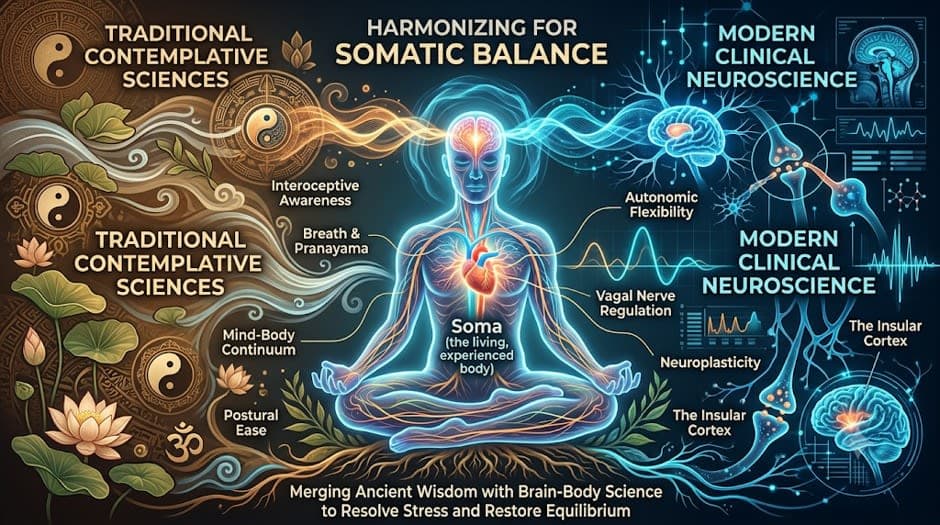
A profound shift is occurring across integrative psychiatry and behavioral medicine. Clinicians and researchers are recognizing that lasting recovery requires working directly through the living body. By combining the experiential depth of ancient contemplative practices with the rigorous explanatory mechanisms of modern affective neuroscience, a unified framework emerges for restoring somatic balance.
Understanding Somatic Balance
To comprehend this therapeutic shift, one must define somatic balance. The term somatic derives from the Greek word soma, referring to the living, experienced body as perceived from within, rather than an external biological object. Somatic balance represents a dynamic state of physiological equilibrium, neurological coherence, and embodied self-awareness. It is not an unmoving state of perpetual relaxation, but rather the organism's fluid capacity to mobilize in response to real-world demands and return smoothly to rest once the challenge passes.
At its core, somatic balance integrates three essential dimensions: autonomic flexibility, neuromuscular ease, and accurate interoception. Autonomic flexibility reflects a resilient vagal brake, allowing rapid shifts between active engagement and peaceful restoration without getting trapped in hyperarousal or numbness. Neuromuscular ease involves releasing chronic postural gripping and visceral bracing that lock traumatic memory into soft tissue. Accurate interoception ensures the brain receives clear, undistorted physiological signals from internal organs without amplifying them into anxiety or suppressing them into detachment. When these systems synchronize, an individual experiences a grounded sense of security, emotional resilience, and authentic connection between mind and body.
The Neurobiology of Chronic Stress and Fragmentation
When a human encounters a perceived stressor, the autonomic nervous system responds instantaneously. The sympathetic branch accelerates cardiovascular activity, mobilizes glucose, and alters muscle tone to prepare for action. Under ordinary circumstances, the parasympathetic nervous system, mediated largely by the vagus nerve, reinstates physiological equilibrium once the threat resolves.
In chronic stress, this adaptive system becomes dysregulated. The nervous system remains locked in persistent vigilance or collapses into functional shutdown. Sustained hyperarousal floods neural tissue with cortisol and inflammatory cytokines, impairing neuroplasticity within the hippocampus and prefrontal cortex. At the same time, hyperactivity within the amygdala keeps subcortical circuits hypersensitive to potential threats.
This state of prolonged distress leads to emotional fragmentation. Individuals lose conscious awareness of their physiological state, experiencing their feelings as overwhelming, diffuse mental storms rather than manageable bodily phenomena. The psychological self becomes detached from the somatic self, manifesting as dissociation, emotional blunting, and an inability to maintain emotional equilibrium.
Ancient Contemplative Wisdom as Somatic Technology
Centuries before neuroimaging revealed the neural correlates of affective states, traditional contemplative disciplines developed sophisticated methods for self-regulation. Eastern traditions, including yogic systems, Buddhist vipassana, and Daoist internal cultivation, approached the human organism as an inseparable continuum of consciousness, breath, and physical structure.
These traditions did not treat physical postures and breathwork as mere fitness routines. They functioned as empirical technologies designed to modulate awareness through precise physiological interventions. Classical pranayama, for example, systematically altered inhalation-to-exhale ratios, recognizing that deliberate manipulation of breath alters mental focus and emotional reactivity. Daoist internal arts cultivated deep interoceptive awareness, teaching practitioners to track micro-sensations across the visceral organs and fascia.
Contemplative traditions understood that attempting to control a disturbed mind solely through cognitive will often amplifies internal tension. Instead, they intervened at the base of the organism. By anchoring attention within physical posture, steadying the rhythm of respiration, and cultivating an accepting, non-judgmental awareness toward internal sensations, ancient practitioners systematically quieted psychic turbulence.
Modern Neuroscience Validates Bottom-Up Regulation
Contemporary clinical neuroscience now provides the empirical scaffolding that explains why these ancient practices work. Central to this understanding is the concept of interoception: the nervous system's capacity to sense, interpret, and integrate signals originating within internal organs, blood vessels, and muscles.
Signals travel continuously from the body upward through afferent vagal pathways into the brainstem, thalamus, and posterior insular cortex. The insula constructs our subjective sense of self and emotional experience based upon these physiological inputs. When an individual suffers from chronic stress, interoceptive processing becomes distorted. Sensation is either amplified into panic or numbed into dissociation.
Contemplative practices train interoceptive precision. Neuroimaging studies demonstrate that regular body-centred mindfulness and deliberate somatic inquiry enhance gray matter density and functional connectivity within the insular cortex and anterior cingulate cortex. By deliberately observing internal physical sensations without reactivity, individuals recalibrate their internal prediction models. The brain learns that physical tension, elevated heart rate, or visceral sensations are transient physiological events rather than catastrophic emergencies.
Furthermore, slow, diaphragmatic breathing with lengthened exhalations stimulates the pulmonary stretch receptors and activates the ventral vagal complex. This bottom-up physiological shift sends unambiguous safety signals directly to the limbic system, down-regulating amygdala reactivity far faster than abstract reasoning can achieve.
Clinical Integration and the Path Forward
The harmonization of contemplative traditions and clinical neuroscience transforms modern treatment modalities. Therapies such as Somatic Experiencing, Sensorimotor Psychotherapy, and Mindfulness-Based Stress Reduction operationalize these combined insights. Rather than treating physical symptoms and psychological distress as separate domains, clinicians help patients track somatic experience in real time.
Patients learn to recognize early somatic precursors of anxiety, such as shallow breathing or tightening abdominal muscles, and respond with targeted physiological regulation before cognitive spirals take over. Through gentle pendulation between comfort and distress, individuals release trapped procedural defence responses, restoring autonomic resilience.
Treating modern chronic stress and emotional fragmentation requires honouring the full biological architecture of the human organism. By integrating ancient contemplative arts with the precision of modern neuroscience, clinical practice transcends intellectualized therapies. It provides individuals with an enduring, biologically grounded path toward true somatic balance and emotional wholeness.