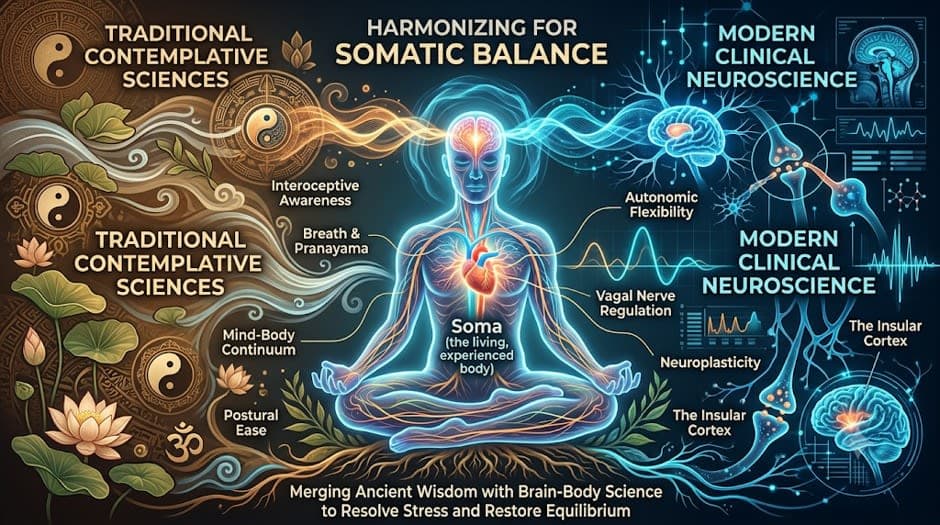

For thousands of years, ancient wisdom traditions maintained that the human breath serves as the master bridge between physical reality and inner consciousness. In yogic philosophies, pranayama was never considered a mere respiratory exercise; it was approached as a sophisticated technology designed to govern life-force energy, dissolve mental turbulence, and alter human physiology. Contemplative practices, ranging from monastic seated meditation to mindful somatic reflection, operated with an intuitive understanding that human consciousness could be systematically trained. For generations, modern scientific materialism viewed these ancient concepts through a lens of scepticism, categorizing them as subjective beliefs or unmeasurable spiritual techniques. Over the past two decades, however, an extraordinary convergence has taken place. High-resolution functional neuroimaging, electrophysiology, autonomic mapping, and cellular diagnostics are revealing that these time-tested contemplative practices represent rigorous, verifiable interventions in human neurobiology.
The foundation of this biological dialogue begins within the autonomic nervous system. Human survival hinges on the balance between two branches: the sympathetic system, which drives vigilance, high output, and fight-or-flight reactions, and the parasympathetic system, which orchestrates digestion, tissue repair, cellular restoration, and calm. Modern professional life often traps individuals in chronic sympathetic hyper-arousal, drowning internal physiology in cortisol and inflammatory biochemical markers. Ancient breathwork directly counteracts this imbalance through the mechanics of respiratory sinus arrhythmia. During purposeful slow breathing, particularly when exhalations are consciously drawn out longer than inhalations, pulmonary stretch receptors inside lung tissue send rapid signals up the afferent fibres of the vagus nerve.
This sensory data enters the nucleus tractus solitarii within the brainstem, which promptly instructs the autonomic network to decelerate heart rate, dilate constricted blood vessels, and elevate heart rate variability. Rather than remaining imprisoned in chronic physiological threat, the brain perceives deliberate exhalation as an unmistakable signal of physical safety. This vagal stimulation suppresses systemic inflammation, decreases arterial stiffness, and restores autonomic balance within minutes. What ancient sages articulated as clearing inner tension, modern clinical medicine measures as targeted parasympathetic tone and increased vagal modulation.
Beyond peripheral cardiovascular shifts, conscious respiration directly reprograms the primary control centres of the brain. Deep within the brainstem sits the pre-Bötzinger complex, a specialized network of interneurons responsible for generating the spontaneous rhythm of breathing. Neuroscientists have identified a direct cellular bridge linking this respiratory pacemaker to the locus coeruleus, the main site of norepinephrine synthesis and the driver of anxiety, alertness, and cognitive arousal. When an individual experiences stress, breathing naturally becomes erratic and shallow, causing the pre-Bötzinger complex to drive the locus coeruleus into overdrive. The resulting flood of norepinephrine heightens emotional distress and triggers defensive cognitive behavior.
When deliberate breath control slows respiration to approximately six cycles per minute, the firing pattern of the pre-Bötzinger complex stabilizes. This mechanical slowing down pacifies the locus coeruleus, reducing the release of stress neurochemicals across the central nervous system. Simultaneously, slow rhythmic air movement through the nasal passages creates oscillating electrical waves that propagate across the olfactory bulb, the piriform cortex, the amygdala, and the hippocampus. This electrical synchronization calms emotional processing centres and prevents emotional hijackings before they take hold, proving that conscious respiration serves as an immediate physical control switch for acute emotional regulation.
While breath manipulation provides immediate stabilization, sustained contemplative meditation fundamentally alters brain structure. Longitudinal magnetic resonance imaging demonstrates that continuous daily meditation induces neuroplastic adaptations, physically restructuring cortical matter. In individuals suffering from sustained cognitive stress, the amygdala, the primitive alarm system of the brain, shows structural enlargement and hyperactivity. With consistent mindfulness practice, the amygdala undergoes noticeable volumetric reduction and reduced baseline reactivity. The individual ceases to interpret mundane daily challenges as survival threats.
Concurrently, contemplative practices drive neurogenesis and cortical thickening across the prefrontal cortex and the anterior cingulate cortex. These regions oversee working memory, executive function, critical reasoning, and deliberate emotional regulation. By strengthening synaptic connections between the prefrontal cortex and the subcortical limbic regions, regular contemplation enhances top-down inhibitory control over instinctual reactions.
Furthermore, daily somatic awareness practices build grey matter density within the anterior insular cortex. The insula functions as the central hub for interoception, the ability of the brain to accurately map internal bodily conditions such as cardiac rhythms, respiratory depth, muscular constriction, and visceral sensations. High interoceptive awareness allows individuals to detect early biological signs of stress and fatigue long before those signals manifest as clinical burnout, exhaustion, or chronic physical illness.
Another significant contribution of clinical neuroscience to the study of meditation is the analysis of the Default Mode Network. Comprising the medial prefrontal cortex, posterior cingulate cortex, and angular gyrus, the Default Mode Network activates whenever an individual is disengaged from goal-oriented tasks. While it serves a role in episodic memory retrieval and social cognition, chronic hyperconnectivity within this network is the primary neurobiological driver of excessive mind-wandering, painful self-criticism, and repetitive rumination. Unchecked, this narrative loop drains energy and is intimately linked with depressive episodes and executive exhaustion.
Functional magnetic resonance imaging confirms that focused contemplative exercises effectively quiet the Default Mode Network. When a practitioner deliberately anchors awareness on the sensation of air entering the nostrils, the cadence of the heartbeat, or a single chosen focal point, neural resources shift from narrative mind-wandering to immediate sensory networks. By routinely quieting the inner narrative machinery, contemplative traditions prevent the mental rumination that exhausts cognitive stamina, creating an inner space characterized by clarity, present-moment focus, and emotional renewal.
These structural and network modifications are accompanied by shifts in continuous neural oscillations. Quantitative electroencephalogram recordings demonstrate that different contemplative techniques produce distinct, measurable electrical brainwave patterns. Simple breath observation elevates alpha wave coherence across the parietal and occipital lobes, indicating a biological state of relaxed, highly efficient alertness. As meditative depth deepens, the brain shifts toward frontal midline theta rhythms, an oscillatory pattern associated with memory consolidation, emotional processing, and creative synthesis.
In long-term practitioners of contemplative traditions, neuroscientists observe sustained, high-amplitude gamma wave synchrony spanning widely distributed cortical regions. Gamma oscillations coordinate communication across distinct brain regions, facilitating hyper-awareness, perceptual clarity, and integrated cognitive performance. What ancient masters recognized as elevated consciousness, neuroscience identifies as coherent large-scale cortical communication.
The biological validation of these ancient practices signals a fundamental evolution in human health and wellness. Breathwork and contemplative traditions are neither esoteric relics nor superficial leisure pursuits. They represent precise, self-directed neurobiological interventions that alter gene expression, fortify neural circuitry, quiet chronic cognitive agitation, and restore systemic equilibrium. By integrating these ancestral practices with the empirical precision of modern neuroscience, individuals gain the tools to manage their internal biology, cultivating resilience, clarity, and sustainable vitality in an increasingly complex world.