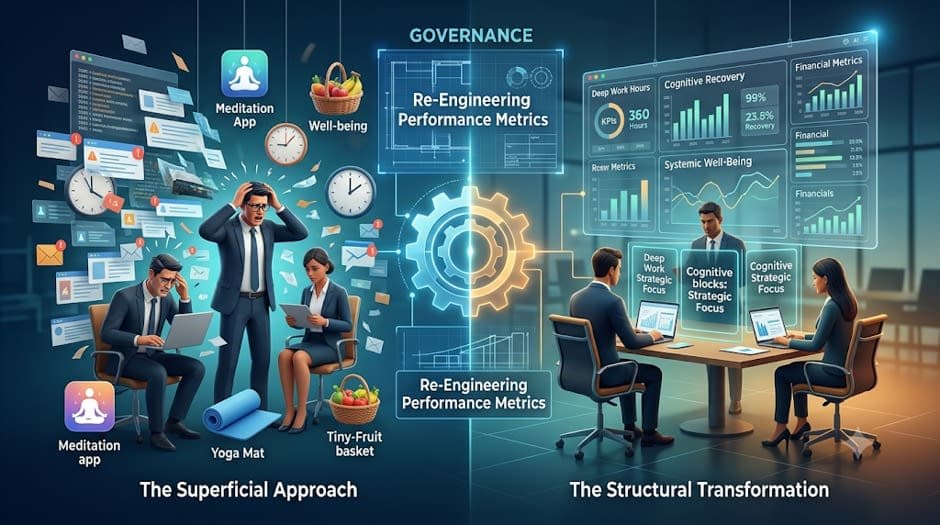

The definition of workplace wellness has fundamentally shifted. A simple snack bar or a discounted gym membership is no longer sufficient to sustain a resilient workforce. The integration of physical, mental, financial, and digital well-being into the daily corporate framework has transformed wellness from a peripheral perk into core operational infrastructure.
The global corporate wellness market has reached $71.89 billion in 2026 and is projected to expand toward $118 billion over the coming years. This rapid trajectory reflects an operational reality: employee burnout, presenteeism, and stress-related turnover represent severe risks to organizational productivity and profitability. Modern forward-thinking enterprises recognize that work-life balance serves as a primary driver for talent retention and long-term organizational success.
This article examines eight core dimensions reshaping workplace health and culture through empirical data, clear focus areas, and real-world case studies.
1. Preventive Mental Healthcare: Moving from Reactive EAPs to Daily Support Systems
Traditional Employee Assistance Programs (EAPs) have historically suffered from low usage, with participation rates often staying below 10%. Modern wellness frameworks replace reactive, crisis-only helplines with daily proactive mental health infrastructure embedded into regular workflows.
Organizations achieve this by integrating on-demand therapy platforms, micro-coaching modules, and daily digital check-ins. Simultaneously, managerial training focuses on building psychological safety, empathetic leadership, and early identification of distress signals.
Comprehensive workplace wellness initiatives generate substantial business returns, with research showing up to a 27% improvement in employee productivity. On average, structured workplace mindfulness and stress reduction programs lower workplace anxiety by 28% and cut clinical depression scores by 26%.
In a notable transformation, a major financial services institution overhauled its health model by introducing mandatory paid wellness days alongside 24/7 access to app-based therapy. Within twelve months, the company recorded a 17% reduction in sick leave usage and a 12% decrease in voluntary turnover among mid-level management.
2. Digital Wellness and Asynchronous Work: Combating "Always-On" Burnout
The expansion of hybrid and remote work environments has blurred the boundaries between personal life and job responsibilities, resulting in widespread digital fatigue and cognitive overload. Addressing this requires clear organizational policies around technology usage and schedule boundaries.
Companies are establishing formal "right to disconnect" guidelines alongside asynchronous communication protocols to remove immediate-response expectations. Additionally, privacy-focused artificial intelligence analytics track workload trends to flag screen exhaustion and recommend structured microbreaks.
Presenteeism—the habit of working while mentally or physically compromised—costs organizations upwards of $150 billion annually. Taking short 5-minute microbreaks every 50 minutes restores cognitive focus and increases sustained daily output by 13%.
Enterprise software leader Salesforce introduced "No-Meeting Fridays" paired with designated asynchronous focus blocks across its engineering divisions. This shift led to a 16% increase in output efficiency and an 18% improvement in self-reported work-life balance scores within six months.
3. Financial Wellness as a Talent Retention Strategy
Financial anxiety remains a primary driver of workplace distraction and chronic stress. Holistic wellness requires employers to address economic security beyond the standard paycheck.
Modern programs offer direct financial coaching, emergency savings matching, and employer-backed student loan repayment contributions. Workshops tailored to different career stages provide practical education ranging from debt management to long-term investment planning.
Employee turnover costs an average of $15,000 per worker, whereas targeted financial wellness initiatives reduce turnover by up to 25%. Furthermore, almost half of modern employees state that structured financial support benefits represent one of the most critical factors in job selection and long-term loyalty.
Global professional services firm PwC launched a student loan paydown initiative, contributing $1,200 annually directly toward the principal debt of its junior staff. This focused financial intervention contributed to a 20% increase in retention rates for early-career associates over three years.
4. Ergonomics and Movement: Redefining Physical Health for Remote Workforces
Sedentary work patterns contribute significantly to musculoskeletal strain, metabolic decline, and fatigue. Physical health initiatives are shifting away from centralized corporate fitness centers toward decentralized support for remote and hybrid teams.
Employers support this shift through dedicated home-office setup stipends for adjustable standing desks and ergonomic seating. Teams also integrate structured movement breaks, posture coaching, and virtual team movement challenges into their weekly routines.
Active movement initiatives lower sick leave days by 25% across participating workforces. Mid-day physical movement breaks drop perceived workplace stress levels by 34%.
Consumer goods giant Unilever deployed a global "Active Working" framework, providing remote workers with ergonomic allowances and access to virtual physical therapists. The initiative drove a 30% reduction in ergonomic-related injury claims over two years.
5. Wearables, AI, and Biomarkers: Data-Driven Personalization in Corporate Wellness
Generic health programs are giving way to data-driven, personalized wellness solutions powered by wearable devices and predictive analytics.
Employees utilize biometrics—such as heart rate variability, sleep quality markers, and recovery tracking—to adjust their daily schedules for peak performance. These systems function under strict privacy frameworks to protect individual health metrics.
Incentivized tracking programs boost overall participation rates to 70%, expanding the financial return on investment to a 4:1 ratio. Combining coaching with biometric feedback adds up to 11 hours of effective productive time per employee each week.
Multinational technology enterprise SAP implemented an opt-in biometric health platform paired with wearable smart rings for high-stress business units. Participants received tailored guidance on recovery, stress management, and sleep timing, resulting in an 8% increase in overall team output capacity.
6. Executive Accountability: Linking Leadership Metrics to Organizational Well-Being
Holistic wellness cannot succeed solely as a bottom-up effort; it requires leadership modeling and accountability at the executive level.
Organizations are tying employee net promoter scores (eNPS), team turnover rates, and health participation metrics directly to executive compensation packages. Concurrently, executive leaders are encouraged to publicly model healthy boundaries by taking complete time off and disconnecting outside working hours.
Industry surveys reveal that 72% of corporate leaders believe executive incentives should be connected directly to workforce well-being metrics. Transparent reporting of internal health outcomes significantly increases organizational trust and engagement.
Health technology firm Philips structured 10% of executive variable compensation around internal employee health, equity, and well-being goals. Within eighteen months, the organization recorded measurable improvements in psychological safety indices and leadership evaluation scores.
7. Psychological Safety and Autonomy: The Structural Pillars of Work-Life Balance
Wellness programs fail when introduced into rigid or untrusting environments. Real work-life integration depends on managerial trust, psychological safety, and schedule autonomy.
Companies are shifting away from micromanagement and strict hour-tracking toward outcome-based performance reviews. Culture strategies ensure employees can discuss workload boundaries and mental health challenges without fear of career setbacks.
High worker autonomy and schedule flexibility increase daily workplace productivity by 13%. Employees who feel supported by direct managers regarding mental health report 70% higher job satisfaction and significantly lower turnover intentions.
Global music platform Spotify adopted a "Work from Anywhere" framework alongside flexible working hours. By evaluating staff entirely on deliverables rather than physical presence, Spotify reduced its global voluntary turnover by 15% compared to industry averages.
8. Inclusive Wellness: Customizing Support for Diverse Workforces
Modern workforces feature varied demographic backgrounds, family structures, and personal priorities. One-size-fits-all benefits packages frequently fail to serve diverse employee segments effectively.
Forward-looking employers offer flexible, modular benefits options covering areas such as fertility care, eldercare assistance, neurodiversity coaching, and specialized health management. Benefits design ensures equal accessibility across remote workers, office-based teams, and operational staff.
Organizations providing inclusive, modular benefits report a 28% increase in employee satisfaction scores. Conversely, rigid benefits models result in up to 68% of wellness resources remaining unused.
Professional services firm EY introduced a flexible benefits account system, enabling workers to allocate health credits across personalized options ranging from parental support to neurodivergent productivity aids. This model increased overall benefits usage from 22% to 78% within two years.
Key Program Benchmarks Summary
Area
Focus
Key Impact Metric
Case Study
Preventive Mental Healthcare
Proactive, daily support systems
+27% overall productivity
Financial Services Firm
Digital Wellness
Asynchronous communication & boundary management
Cuts $150B presenteeism loss
Salesforce
Financial Support
Coaching, savings match & loan aid
-25% voluntary turnover
PwC
Physical Movement
Ergonomic stipends & posture guidance
-25% sick leave usage
Unilever
Biometric Analytics
Wearables & customized health insights
4:1 return on investment
SAP
Leadership Metrics
Executive compensation tied to team health
72% executive endorsement
Philips
Autonomy & Trust
Outcome-based performance evaluation
+13% daily output
Spotify
Inclusive Benefits
Modular choices for diverse demographics
+28% employee satisfaction
EY